Recent Developments in Japanese Competition Law: Through the Lens of Innovation
On September 18, I gave a presentation titled “Recent Developments in Japanese Competition Law: Through the Lens of Innovation” at the “2026 Korea-Japan Competition Law Academic Research Conference (2026 한일 경쟁법연구 학술교류대회),” held at Korea University in Seoul. The conference was co-organized by the Korea Competition Law Association (KCLA) and the Japan Association of Economic Law, and doubled as an exchange between Korean and Japanese economic law scholars.
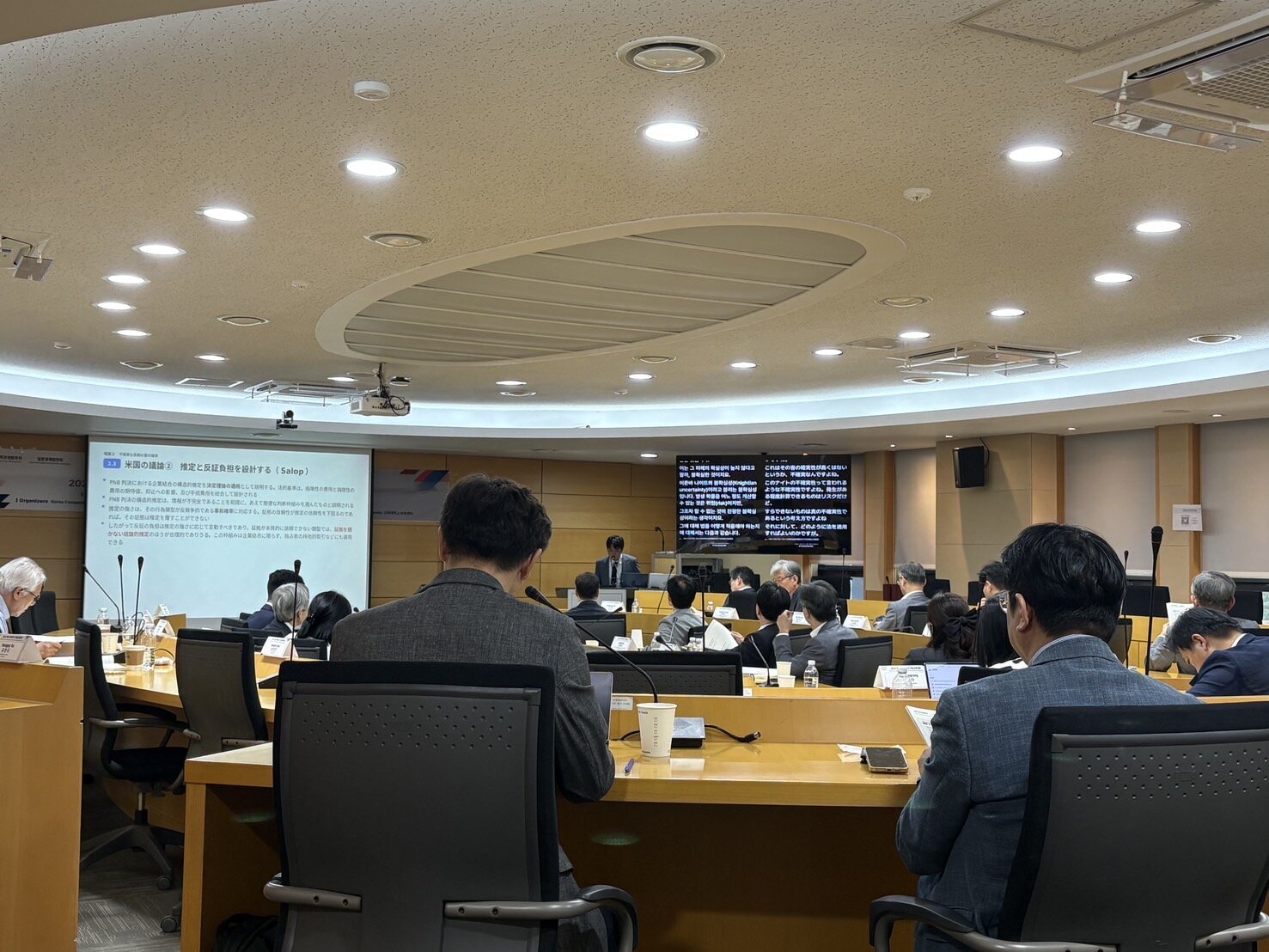
I was originally asked to speak on “recent developments in Japanese competition law and policy.” But an exhaustive survey of Japanese developments would not make good material for discussion among researchers, so I chose to examine Japanese competition law enforcement critically through the lens of innovation. I chose innovation because it covers recent new issues while also giving a cross-cutting view of the whole of enforcement.
The presentation builds on my article in Kosei Torihiki no. 892, “Strategic Conduct Aimed at Excluding Competitors and Innovation”, and my research on predatory innovation presented at the Japan Competition Law Forum.
In antimonopoly law, innovation appears both as a factor in assessing the legality of individual conduct and as a goal (or slogan) of competition policy. I organized the presentation along these two axes.
For the former, I reorganized the discussion not by type of conduct but by “which question we are trying to answer”: how to distinguish legitimate innovation from unlawful exclusion; with what probability to anticipate uncertain long-term harm; and how to weigh short-term harm against long-term benefits. Divided this way, it becomes clear that Japanese cases and debate are heavily skewed across the questions. The first question has a small number of important cases, such as the printer litigation over technological tying; the second has no cases; and for the third, a framework has been set out only in the context of merger control. On the second question, I also took up U.S. debates that have not yet been sufficiently introduced in Japan, such as Hemphill and Wu on acquisitions of nascent competitors and Salop on designing presumptions and burdens of rebuttal from error costs.
For the latter, I took up the JFTC’s statement of January 2026, “Proactive Development of Competition Policy for the Promotion of Innovation,” and the guidelines on transactions in intellectual property of June of the same year. I pointed to a structure in which, under the framework of abuse of a superior bargaining position, “hindering innovation” is asserted as a harm, yet proof of harm at the market level is never required.
Finally, I took up remedy design, comparing the JFTC’s Google order and MC Data Plus order with the final judgment in the U.S. Google case. Japanese law incorporates effects on innovation into its theory of harm when assessing legality, yet at the remedy stage it is not designed to adapt to technological change. I presented this asymmetry as a challenge for Japanese law.
It was a very stimulating conference and, I think, a wonderful meeting that promises more active academic exchange between Korea and Japan. My sincere thanks to the Korean and Japanese colleagues who worked to plan and run it, and to everyone who asked questions and offered comments.
This post was translated from the Japanese original.